Sunday, 12 July 2015

Thursday 2nd July - Charleville

Thursday 2nd July

On Thursday we went the Cosmos Centre. At the Cosmos Centre we went on a tour. But before the tour we saw space junk.
This is space junk.
On the tour we got to hold asteroids and compare them with normal rocks that we find in the river beds. I learnt that asteroids are heavier then normal rocks their size. 
This is me holding the asteroid call Jack. Look how heavy the asteroid is compared with a normal rock. 
Mum's note:
Before we got to the Cosmos Centre we stopped at the Stiger Vortex Guns. These were brought to Charleville in 1902 by a meteorologist by the name of Clement Wragge. The same technology had been used successfully in Europe to prevent hail-bearing clouds from damaging crops. They produced a vertical pressure wave from a gunpowder explosion, and it was hoped that they would force clouds to release rain on the drought stricken Charleville area. Eventually it rained naturally. Enough said.
The two surviving Vortex Guns.
Mr. Wragge was also the first person to give personal names to cyclones, and named a few after politicians who he considered to be "natural disasters"! Turns out, said politicians didn't see the funny side of that....

At the Cosmos Centre we listened to a talk about meteorites and enjoyed an interactive area covering meteorite impacts, the effects of speed on time and mass, and the history of astronomy vs astrology. The space junk is the remains of a fuel cell.
A button meteorite. If you want to find one of these, apparently the best place is to look inside an emu.
Emus eat stones (gastroliths) for aiding digestion, and prefer anything shiny, including button meteorites.
A slice of the Esquel Meteorite with olivine crystals embedded in a nickel-iron matrix. Amazing!
Caleb playing a game showing what would happen if one of 4 different size asteroids were to hit earth.
Isabel finding out what would happen if you tried to travel near to the speed of light.

Saturday, 11 July 2015

Wednesday 1st July - Charleville

Wednesday 1st July

On Wednesday we drove to a caravan park 8km from Charleville called the Evening Star. On the way we saw a teddy crossing sign in Tambo. 
This is a teddy-bear crossing sign. 
We also saw fossilised wood in Alpha. At lunch time Caleb found two kookaburra feathers.
This is petrified wood.
Mum's note:
Before we left Rubyvale caravan park this morning we feed the rainbow lorikeets some apple. 
Rainbow lorikeets REALLY like apple!
And Caleb has just removed pirate from his career choice list.....
We had lunch in Alpha. Alpha has (by far) the cheapest bakery we have come across in our travels, yet nicer food than most. We certainly regretted packing sandwiches today, but enjoyed our sticky buns nonetheless.
While we had lunch in Alpha we were joined by a flock of Apostlebirds (also known as Happy Jacks).
These birds have a serious lack of need for personal space.....
Alpha also has some pretty impressive murals.
We stopped in Tambo long enough for Paul to take a conference call. In this time, Isabel managed to teach Caleb how to swing upside down on the playground, a feat that they were both very proud of.
Caleb showing off his new skill!
Tambo is also Bottle Tree country.
On our way out of Tambo we found this very fun sculpture. I especially like the hood ornament.
The most excellent kind of road train!
Complete with fun hood ornament to brighten your day!

Tuesday 30th June - Rubyvale

Tuesday 30th June

On Tuesday we went to Policeman's nob. (Policeman's Nob is a little old under water volcano but it is not under water anymore). At Policeman's Nob we climbed up the volcano and we also saw lots of rock wallabies. 
These are the rock wallabies. Can you see all five? 
This is me and Caleb putting a rock on the cairn on top of Policeman's Nob.
This is Policeman's Nob. Can you see it through the trees? 
After we went to Policeman's Nob we went panning for sapphire in the creek bed. When we were panning for sapphire we met some German people. The German people had found lots of sapphires, even really big ones. (Sapphires can come in any shape and colour apart from red. The red ones are called rubies.) 
This is a hole that the German people dug. 
This is another hole that the German people dug.
After we went digging for sapphire in the creek bed we went back to the caravan park. At the caravan park we put some of the rocks that we dug up in the willoughby. (A Willoughby is a plastic tub with water in and has a metal ring attached to a pole and you push the pole up and down to make all the sapphires and zircons and maybe even rubies go to the bottom of the sieves). 
This is me using the willoughby.
This is also me using the willoughby.
Mum's note:Policeman's Nob is the basalt plug that remains after the rest of the volcano has eroded away. There is a colony of rock-wallabies (they look like brush-tail wallabies) living on this mound. They are fairly relaxed about human visitors - although they do not like being too close, they simply move around the basalt mound until they feel safe again. Consequently, you can get a great view of the wallabies as you climb to the summit and back.
Who you looking at?! Rock-wallaby on Policeman's Nob.

We didn't find any valuable gems today, but we did have the satisfaction of choosing our own fossicking spot and using our new knowledge to find some small sapphire and zircon pieces without assistance.
Caleb inspecting Mum's dig site, where she did find a couple of really small gems.

Wednesday, 8 July 2015

Monday 29th June - Rubyvale

Monday 29th June 

On Monday we went on a tag-along-tour for looking for sapphires. On the tag-along-tour we got to have someone else's wash because it was abandoned in its bucket at the willoughbys and the tour guide said he wanted his bucket back.
This is Dad digging.
This is me separating the wash from the dust and the big rocks.
This is me using the willoughby.
This is me tipping the rubbish rocks away.  
This is us going fossicking with the funncat again. 
Mum's note:
On the tag-along-tour we found out where the sapphires are in the soil strata (the wash) and how to separate them from the surrounding rock using tumblers and willoughbies. The tumblers separate out all the big rocks and the soil from the size rocks that are likely to include sapphires of worth. The willoughbies are for washing the tumbled rocks and for getting some separation based on density (sapphires are heavy for their size). Isabel has a detailed description of the willoughbies to post tomorrow.
Caleb turning the handle on the tumbler while Dad feeds in wash.
Caleb helping Dad put wash through the willoughby.
We did find one nice size sapphire - a green one. The piece we found has bronzing on one side, making it a star sapphire. It will be difficult to cut to great effect though, as the bronzing is on one of the smaller faces, so for now it will stay rough. 
The colour was too hard to capture, but you can see this rock is letting the light through.
It is a green sapphire - not what we would think of as a sapphire, but apparently very popular in China. 
The bronzing on one edge of our sapphire.
It was hard to make the kids feel that they'd found much in the way of gems today, as the wash was real rather than spiked, so we headed back to MaxiGems for another couple of buckets of tourist wash to finish off the day.
Back at the caravan park we spotted this little guy on the stump outside our van.
Very serene little tree frog.

Sunday 28th June - Rubyvale

Sunday 28th June

On Sunday we went to church. After church we went fossicking for sapphire in a creek bed but all we found is a piece of glass. After having no luck we bought two $10 buckets with wash in and lots of sapphire in even green. After we did the real fossicking we got to pat a friendly cat.
This is me using the willoughby first time ever. 
This is me looking in the wash for sapphire.
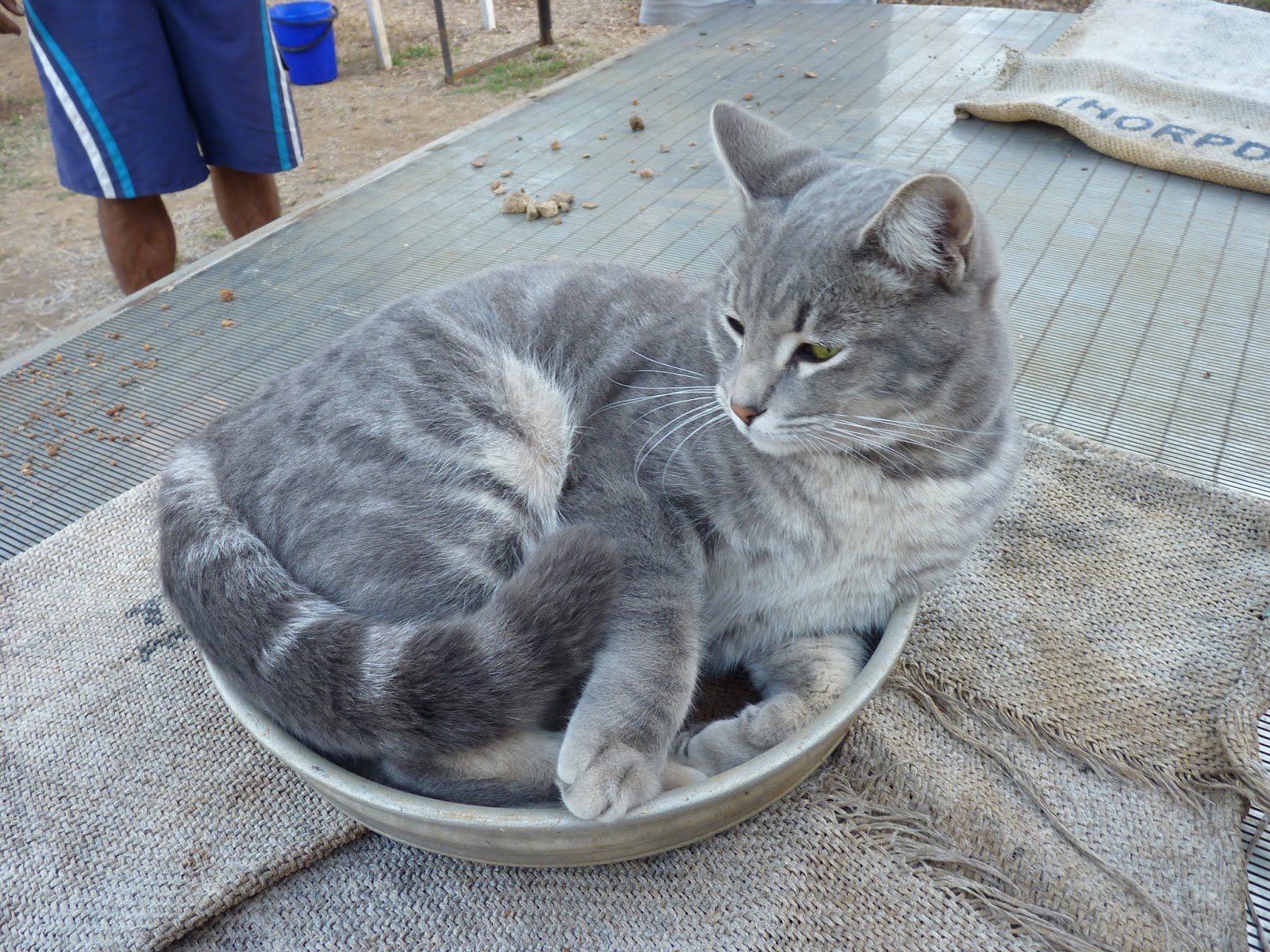
This is the funny cat his name is Mordecai.
These are my sapphires I found.
Mum's note:
Around Sapphire and Rubyvale (communities about 7km apart) is the Rubyvale, Sapphire and Scrub Lead Miners Common. The Common is an area around and in the towns where locals can keep a small number of livestock for a dollar or two per head per year. One cow called Jumpy likes to jump the grid from the Common into the caravan park and eat the citrus trees.
This is Jumpy. She was about to do her "jump the grid" trick for us when the caravan park owner came to find out why we'd stopped our car. Needless to say, she was sprung and sent on her merry way this time.
In the Gemfields there are two types of fossicking land - designated fossicking land where mining claims can be made and machinery is allowed, and fossicking areas where all mining is hand tools only and restricted to holes less than 2m deep. We went for a drive out to the fossicking land around Rubyvale and had a look around. We plan to do a sapphire-finding tour tomorrow anyway, but it was quickly obvious that we have no idea where to start to have a remote hope of finding gems.
Looking around the designated fossicking land.
No permanent dwellings are allowed on the fossicking land around Sapphire and Rubyvale, so this is typical of the buildings outside the town limits. 
Sign says it all really.
Sieving for cats.... found a big one! Yay!
The owner of the cat (and professional tourist miner - ie mines tourists for cash)
from MaxiGems has lived here all his life and spun us some good yarns.

Tuesday, 7 July 2015

Saturday 27th June - Rubyvale

Saturday 27th June

On Saturday we drove from Charters Towers to Emerald but we decided we didn't want to stay there so we drove 45 more minutes to Rubyvale. At Rubyvale we booked 4 nights in a caravan park that looks after brush tail possums and most nights little kangaroo things that look like rats called bettongs.
This is a cotton bush with flowers on.
This is a bettong.
These are the possums.
Mum's note:
On the way to Emerald we saw cotton growing wild on the roadsides and the coal mine at Clermont. We stopped for lunch at a roadhouse and got mobbed for our food by rainbow lorikeets. 
There was a whole flock of them but these two lorikeets were the ringleaders.
"Remember..... I'm a dinosaur....... give me your lunch!"


The big mining bucket at Clermont before getting to Emerald.

At Emerald we saw the "largest painting in the world on an easel", one of a set of seven Van Gogh reproductions planned around the world. We did decide to move onto Rubyvale, although we had planned to stay in Emerald. We had made better time than we expected, so we decided we could stay in the Gemfields instead of 45 minutes away.
The big painting at Emerald.